
|
Photo taken inside of a glacier on April 14th, 2022. 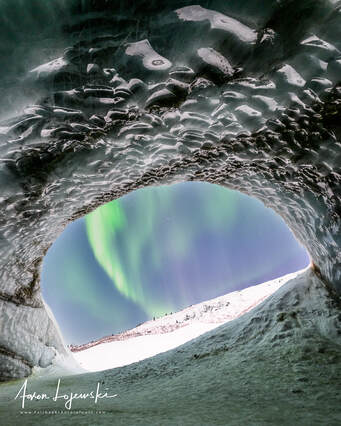 The hard truth is nobody knows for sure exactly when the best day will be. I've seen breathtaking aurora displays during every single month of the season but my favorite time of all is April. Read to the end to find out why. Within a roughly 3 day time horizon, there are some forecasts that are reasonably accurate for predicting the northern lights like at NOAA's Space Weather Prediction Center's forecast. Beyond that timeline, forecasts are typically highly inaccurate. I repeat, beyond that time frame they are typically highly inaccurate. Asking what day is going to be the best, weeks or months out, is like asking for advise on which lottery ticket you should buy (except with Fairbanks Aurora Tours odds are stacked in your favor, not against you). The aurora has a high degree of variation from night to night and ultimately watching it is like fishing, you need to put your line or dipnet in the water and be patient. For aurora viewing, that means going outside around solar midnight, getting away from light pollution, and looking and waiting for the magic to begin. It also must be dark outside. As far north as Fairbanks, AK is, we only get civil twilight at "night" near June 21st. Therefore, the best time to come is anytime between August 21st and April 21st when you have time and the means to and it is dark in Fairbanks. Nobody is getting any younger. Seize the day. Solar activity?Scientists have identified, in general, that there is better alignment of the polarity of the solar wind with earth's geomagnetic field around the equinoxes. This should result in, on average 20-30%, more induction of the solar wind at that time and a increased chance of active aurora. Therefor, with respect to solar activity alone, the months close to the equinox (that is September, October, March, and April) have better odds of active aurora. For example, in this scientific article from Geophysical Research Letters, it is stated that "Global geomagnetic activity show a dominant annual variation with equinoctial maxima alternating between Spring ... and Fall." What about weather patterns?This is something that people rarely ask about but is far more important than any solar trend. From my perspective the worst weather conditions are that in which it is raining or snowing. Dry is better. Based on the data the driest time of the entire aurora season is from April 11th to April 20th where on average there is 0.00 inches of precipitation! It is also very close to the Spring Equinox, hint hint. Unfortunately there is a pervasive myth that the aurora magically and suddenly disappears April 1st so few travelers come up to enjoy this time. Generally though, as the aurora season progresses the historic average precipitation falls. Our summer is our wet season and August / September catch the tail end of it. 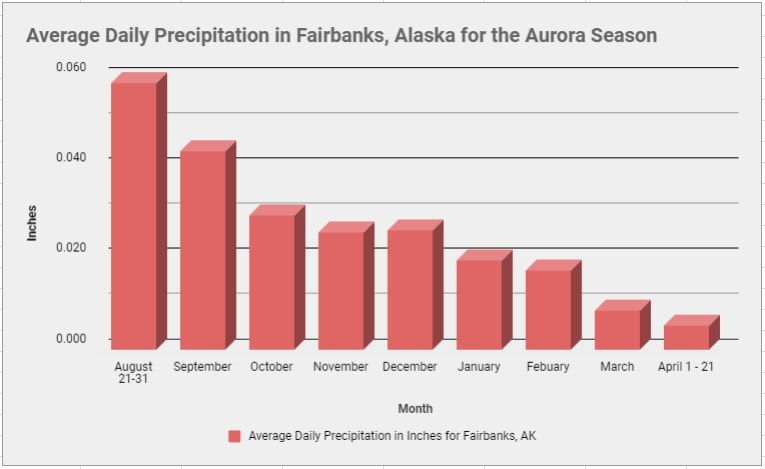 ConclusionThe best time to come is when you are able to from August 21- April 21. Should you have the luxury of picking your time and not having it dictated by practical life considerations, I suggest April for the following reasons.
1. It is close to the Spring Equinox when aurora is more likely to be active. 2. It has the driest streak of historical weather during the entire season and as a month is the driest of them all. 3. It is far warmer than the other months (except August and September but they get a lot more precipitation) 4. Since there is a myth that the aurora magically disappears April 1st, far fewer people come to enjoy the lights and due to less demand: A. Flights are less crowded and cheaper. B. Hotels are less crowded and cheaper. 5. Lastly, did I mention it is likely to be warmer, dryer, less expensive, less crowded, and have increased odds of active aurora?
4 Comments
Brogan from Seattle
12/31/2019 09:03:06 am
Great write up. Good Hint Hint. Coming up March28-4/4......so hoping for best. Staying up at Kory’s, will have truck but may choose chasing for some of us. Great philosophy. Do,the Chair Time. One best show started 4:30 ....2 hrs of Firehoses. (Oct 18-19, 2017) KEEP LOOKING UP
Victor Trombettas
12/16/2023 06:52:27 am
Hi there. Thanks for this post. appreciate the advice. My concern is if we come in April, we may not be able to take advantage of glacier cruises within a drive from Anchorage. Leave a Reply. |
AuthorAaron Lojewski is a long time Fairbanks resident, Tour Guide, and Aurora / Northern Lights photographer. ArchivesCategories
All
|
 RSS Feed
|
Pick Up Locations
|
Fairbanks Aurora Tours LLC © COPYRIGHT 2024 ALL RIGHTS RESERVED.